July Newsletter

New Member!

 
Hello everybody!
 
My name is Murphy Olmstead and I am the newest addition to Wittmeyer & Associates. I am the step-son to Jane and joined the team as an Associate to gain knowledge in public policy and issues involving charter schools. I am a proud University of Idaho alumni and have spent my last 3 years as a Recruiter for a financial services firm. I am excited to meet all of you and eager to be working with everyone involved in the coalition.
 
On another note, we are still actively looking for people who would like to join the coalition! Whether they’re a student, parent, teacher or a supporter of educational innovation through Public Charter Schools, there is a place for you within the Coalition of Idaho Charter Schools. We are looking for those right people who want to get on to our board of directors with the coalition as well. Whether it's writing a letter or attending a rally, find out how you can get involved and what you can do to help the cause!
 
The best way to get involved with the coalition starts with attending our 2018 Parent Advocacy Boot Camp! This is a trip to Washington D.C with parents that supports and defends parents’ rights to access the best public school options for their children. The Boot Camp will teach on ways to advocate and create different public school options, including charter schools, online schools, magnet schools, open enrollment policies and other innovative education programs. If you are interested, please do not hesitate to call or e-mail me! We would love to have you come.
 
Lastly, we are having a Board meeting for the Coalition that is set for Thursday, August 24th. We would love to have as many people as we can come and attend the meeting. It will be a good way for everyone to get to know more about the group and ways we can stay in touch.
 
I hope everyone is having a great summer and I look forward to getting to meet you all!


JULY ARTICLES

Uncharted Charter

by Keith Cousins, Coeur d’Alene Press

COEUR d’ALENE — Another year, another snub for Coeur d’Alene Charter Academy.

One of the nation’s top-performing high schools, Coeur d’Alene Charter Academy was once again not recognized in the U.S. News and World Report’s rankings of the top high schools in Idaho. The school had previously appeared on the list as one of the top 50 in the country, but has not appeared in the rankings in recent years. That prompted school officials and leaders with the state’s charter school network to hire a lawyer for further investigation.

“It’s very frustrating still. It gets more and more frustrating each year it happens,” said principal Dan Nicklay, whose students consistently lead the state in test scores and routinely go on to some of the best universities and colleges in the country. “The data is sitting there, right for the taking, and they just can’t get it from point A to point B.”

U.S. News and World Report began compiling and publishing high school rankings in 2007 with the goal of providing “a clear, unbiased picture of how well public schools serve all of their students in preparing them to demonstrate proficiency in basic skills as well as readiness for college-level work.” According to its website, the media organization works with a nonprofit social science research firm, RTI International, to create a methodology of ranking based on four factors: basic data from the U.S. Department of Education, Advanced Placement test data, International Baccalaureate test data, and each high school’s statewide test results and graduation rates.

Read More..

http://nypost.com/2017/07/06/de-blasio-releases-details-of-side-deal-on-charter-schools/


SCHOOLS RECEIVE $30.3 MILLION IN LOTTERY PROCEEDS

Idaho schools received a $30.3 million check from the Idaho Lottery Thursday.

The dividends — $30,312,500, to be exact — represent the schools’ share from 2016-17 ticket sales of about $240 million.

The proceeds still represent but a sliver of Idaho’s school funding. The K-12 system will receive close to $1.7 billion in sales and income tax revenues in 2017-18 — and that doesn’t count the hundreds of millions of dollars schools collect in local property taxes.

But state officials and lottery administrators celebrated the dividends during a ceremony in Gov. Butch Otter’s office Thursday afternoon. Lottery director Jeff Anderson said the state is nearing a milestone; since its inception in 1989, the lottery has awarded nearly $800 million in dividends for schools and state buildings.

“That’s quite a feat,” said Lt. Gov. Brad Little, who stood in for Otter Thursday.


Lt. Gov. Brad Little, state superintendent Sherri Ybarra and state lottery director Jeff Anderson pose with an oversized check representing the K-12 cut from 2016-17 lottery ticket sales.

The lottery money does not go into salaries and benefits, but instead goes to one-time capital projects. About $18 million goes into a fund school districts can tap into for repairs and improvements. The remaining $12 million goes into the state’s Bond Levy Equalization Fund, which is designed to mitigate some of the cost of building bond issues in rural and poorer school districts.

Read More…

https://www.idahoednews.org/news/schools-receive-30-3-million-lottery-proceeds/

re


Questions?

Call Murphy Olmstead (208) 871-3885
murphy@wittmeyerassociates.com

June Newsletter

6/19/17


The Coalition Board hopes that you are enjoying the summer! It goes by very quickly and we wanted to keep in touch with you about a few things that affect you, your students and your Charter School!

As many of you know, some Idaho Legislative Committees continue to work over the Summer (often called Interium Committees). They work on issues that were not finished during Legislative Session (January through late March) or on new issues that come up—such as new Idaho rules or regulations from Washington, DC.

We want to advise you about an upcoming Committee meeting—Public School Funding Formula Committee. It will meet on June 20, at 9 am in Room East Wing in the Capitol. It is open to the public. 

The Coalition and several virtual schools will attend. We will advise you if the Committee takes adverse actions toward virtual schools. We are particularly concerned about the issue of Idaho’s Accountability Framework. The Coalition members may need to provide information to the Committee members encouraging Legislators to encourage simplicity in Accountability.

Below is a fun and interesting article about American’s knowledge – or lack of knowledge—of our food!!

The surprising number of American adults who think chocolate milk comes from brown cows

By Caitlin Dewey June 15 

 Play Video 1:30

5 surprising things many Americans get wrong

Seven percent of American adults believe chocolate milk comes from brown cows, according to a recent online survey commissioned by the Innovation Center of U.S. Dairy. Here are a few other things Americans get wrong. (Elyse Samuels/the Washington Post)

Seven percent of all American adults believe that chocolate milk comes from brown cows, according to a nationally representative online survey commissioned by the Innovation Center of U.S. Dairy.

If you do the math, that works out to 16.4 million misinformed, milk-drinking people. The equivalent of the population of Pennsylvania (and then some!) does not know that chocolate milk is milk, cocoa and sugar.

But while the survey has attracted snorts and jeers from some corners — “um, guys, [milk] comes from cows — and not just the brown kind,” snarked Food & Wine — the most surprising thing about this figure may actually be that it isn’t higher.

Wonkbook newsletter

Your daily policy cheat sheet from Wonkblog.

Top of Form

Bottom of Form

Sign up

For decades, observers in agriculture, nutrition and education have griped that many Americans are basically agriculturally illiterate. They don’t know where food is grown, how it gets to stores — or even, in the case of chocolate milk, what’s in it.

One Department of Agriculture study, commissioned in the early ’90s, found that nearly 1 in 5 adults did not know that hamburgers are made from beef. Many more lacked familiarities with basic farming facts, like how big U.S. farms typically are and what food animals eat.

Experts in ag education aren’t convinced that much has changed in the intervening decades.

“At the end of the day, it’s an exposure issue,” said Cecily Upton, co-founder of the nonprofit FoodCorps, which brings agricultural and nutrition education into elementary schools. “Right now, we’re conditioned to think that if you need food, you go to the store. Nothing in our educational framework teaches kids where food comes from before that point.”

Upton and other educators are quick to caution that these conclusions don’t apply across the board. Studies have shown that people who live in agricultural communities tend to know a bit more about where their food comes from, as do people with higher education levels and household incomes.

But in some populations, confusion about basic food facts can skew pretty high. When one team of researchers interviewed fourth-, fifth- and sixth-graders at an urban California school, they found that more than half of them didn’t know pickles were cucumbers, or that onions and lettuce were plants. Four in 10 didn’t know that hamburgers came from cows. And 3 in 10 didn’t know that cheese is made from milk.

“All informants recalled the names of common foods in raw form and most knew foods were grown on farms or in gardens,” the researchers concluded. “They did not, however, possess schema necessary to articulate an understanding of post-production activities nor the agricultural crop origin of common foods.”

In some ways, this ignorance is perfectly logical. The writer and historian Ann Vileisis has argued that it developed in lockstep with the industrial food system.

As more Americans moved into cities in the mid-1800s, she writes in the book “Kitchen Literacy,” fewer were involved in food production or processing. That trend was exacerbated by innovations in transportation and manufacturing that made it possible to ship foods in different forms, and over great distances.

By the time uniformity, hygiene and brand loyalty became modern ideals — the latter frequently encouraged by emerging food companies in well-funded ad campaigns — many Americans couldn’t imagine the origins of the boxed cereals or shrink-wrapped hot dogs in their kitchens.

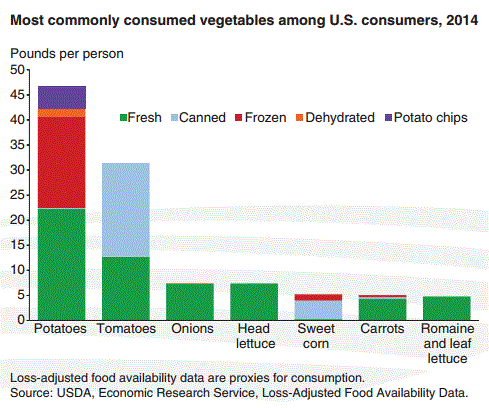
Today, many Americans only experience food as an industrial product that doesn’t look much like the original animal or plant: The USDA says orange juice is the most popular “fruit” in America, and processed potatoes — in the form of french fries and chips — rank among the top vegetables.

“Indifference about the origins and production of foods became a norm of urban culture, laying the groundwork for a modern food sensibility that would spread all across America in the decades that followed,” Vileisis wrote, of the 20th century. “Within a relatively brief period, the average distance from farm to kitchen had grown from a short walk down the garden path to a convoluted, 1,500-mile energy-guzzling journey by rail and truck.”

The past 20 years have seen the birth of a movement to reverse this gap, with agriculture and nutrition groups working to get ag education back into classrooms.

Aside from FoodCorps, which worked with slightly more than 100,000 students this year, groups like the National Agriculture in the Classroom Organization and the American Farm Bureau Foundation are actively working with K-12 teachers across the country to add nutrition, farm technology and agricultural economics to lessons in social studies, science and health. The USDA Farm to School program, which awarded $5 million in grants for the 2017-2018 school year on Monday, also funds projects on agriculture education.

For National Dairy Month, which is June, NACO has been featuring a kindergarten-level lessonon dairy. Among its main takeaways: milk — plain, unflavored, boring white milk — comes from cows, not the grocery case.

Nutritionists and food-system reformers say these basic lessons are critical to raising kids who know how to eat healthfully — an important aid to tackling heart disease and obesity.

Meanwhile, farm groups argue the lack of basic food knowledge can lead to poor policy decisions.

A 2012 white paper from the National Institute for Animal Agriculture blamed consumers for what it considers bad farm regulations: “One factor driving today’s regulatory environment ... is pressure applied by consumers, the authors wrote. “Unfortunately, a majority of today’s consumers are at least three generations removed from agriculture, are not literate about where food comes from and how it is produced.”

Upton, of FoodCorps, said everyone could benefit from a better understanding of agriculture.

“We still get kids who are surprised that a french fry comes from a potato, or that a pickle is a cucumber,” she said. “... Knowledge is power. Without it, we can’t make informed decisions.”

Update: This story originally said the survey in question was commissioned by the National Dairy Council. It was actually commissioned by the Innovation Center of U.S. Dairy, its sister organization. The Post regrets the error. 

The surprising number of American adults who think chocolate milk comes from brown cows - The Washington Post


https://www.washingtonpost.com/news/wonk/wp/2017/06/15/sev


5/30/17

5/30/17

The Coalition of Idaho Charter School Families is pleased to announce that we had an abundant of parents sign up to attend the Washington DC Boot Camp that is held every July. Three Parents will attend this year’s Camp. We have a waiting list for next year of 7. We appreciate the interest from Idaho’s Charter School parents in learning more about how to maintain support charter schools. 

We all appreciate the need to maintain parent support for Charters.  In Idaho, as in most states, we often have to fight hard against those that do not want Charter Schools—especially virtual schools. Even now, in Idaho, there are individuals and groups that work hard to eliminate charter schools. See below.  The Coalition is here to protect Parent Choice in Schools. 

If you are interested in helping protect your ability to choose your student’s school, I urge you join the Coalition and lend your voice to keep Charters open. I have listed the RENEWAL SCHEDULE FOR PCSC-AUTHORIZED SCHOOLS. If your school is on the renewal list for Renewal you may want to learn more about what you can do. 


  • RENEWAL SCHEDULE FOR PCSC-AUTHORIZED SCHOOLS

Statute requires that the performance certificates for existing schools ensure all schools will be evaluated for renewal or nonrenewal between March 2016 and March 2019.

The PCSC will schedule initial renewal considerations for the existing schools it authorizes based on their 2013 Star ratings. All schools will receive at least two, annual reports from the PCSC prior to the year in which they will be considered for renewal or non-renewal, permitting ample time to correct any shortcomings. In accordance with statute, new schools will receive performance certificates with an initial term of three years, and will be added to this schedule accordingly.

2017

Heritage Academy

Succeed Virtual High School

Kootenai Bridge Academy

Wings Charter Middle School

Idaho Connects Online (ICON)

Another Choice Virtual School

Richard McKenna Charter High School

American Heritage Charter School

Chief Tarhgee Elementary Academy

Odyssey Charter School

Syringa Mountain School

Bingham Academy

The Coalition of Idaho Charter School Families believes that the current “process” should be changed and will work with families and schools to prevent Charters from closing.

  Contact Us

Coalition of Idaho Charter School Families

PO Box 6236 | Boise, ID 83707-6236

877-792-5900

idschoolchoice@gmail.com


Teacher of the Year Commits the Unpardonable Sin: Working at a Charter (Op-Ed)

National Review |  By Paul Crookston, May 25, 2017
A public-school teacher who focuses on social justice won the 2017 teacher of the year award, but public-school teachers’ unions in her home state refuse to acknowledge the honor. Why? Because Boston teacher Sydney Chaffee teaches at a public charter school — and that fact is enough to designate her as an enemy of the Massachusetts Teachers Union (MTA). In the past, the MTA has rolled out the red carpet at their convention for the winners of teacher-of-the-year awards. This year, they have the state’s first ever national teacher of the year, and in lieu of inviting her to speak and offering a stipend, the MTA refused to even approve a congratulatory letter. 

Additional Sources:

  • Mass. teachers union snubs National Teacher of the Year(MA) Commonwealth Magazine |  By Michael Jonas, May 25, 2017
  • They Voted to Snub Her. We Celebrate Her, Good School Hunting |  By Erika Sanzi, May 25, 2017


4/20/17 Newsletter

Coalition of Idaho Charter School Families

4/20/17

Hello Mr. Chairman and Members of the Idaho Public Charter School Commission.  My name is Tom LeClaire and I am President of the Coalition of Idaho Charter Schools Families.  Thank you for inviting our organization to speak with you today. 

We are very concerned with the impact of the current efforts of the IPCSC staff to add more regulatory oversight to the already heavily regulated charter schools in Idaho.  The legislative intent, provided below, is clear as to what the legislators wanted and that is what the PCSC should follow.  We strongly support these statements.

33-5202.  Legislative intent. It is the intent of the legislature to provide opportunities for teachers, parents, students and community members to establish and maintain public charter schools which operate independently from the existing traditional school district structure but within the existing public school system as a method to accomplish any of the following:

(1)  Improve student learning;

(2)  Increase learning opportunities for all students, with special emphasis on expanded learning experiences for students;

(3)  Include the use of different and innovative teaching methods;

(4)  Utilize virtual distance learning and on-line learning;

(5)  Create new professional opportunities for teachers, including the opportunity to be responsible for the learning program at the school site;

(6)  Provide parents and students with expanded choices in the types of educational opportunities that are available within the public school system;


(7)  Hold the schools established under this chapter accountable for meeting measurable student educational standards.

Unfortunately, the simplicity of the legislative intent language has, over time, evolved into a quagmire of different Rules that are being written by Commission staff with little or no input from the schools that will have to comply with them.  Charter schools go through rigorous accreditation by professional, experienced individuals.  Accreditation plus state standards are already in place for ALL schools, is the appropriate yardstick for charters.  No need for all the extra and discretionary burdens that the Commission staff is proposing.  We need to get this conversation on the table, because what the Commission staff is doing, is saying that we don’t want to be accountable.  That is not true.

 #7 of the legislative intent is addressed in State Board of Education Rules Governing Thoroughness.   The introduction to the “Accountability Rule in the Rules Governing Thoroughness” says this, "School district, charter school district and public charter school accountability will be based on multiple measures aimed at providing meaningful data showing progress toward interim and long-term goals set by the State Board of Education for student achievement and school improvement. The state accountability framework will be used to meet both state and federal school accountability requirements and will be broken up by school category and include measures of student academic achievement and school quality as determined by the State Board of Education."  This existing rule includes ISAT proficiency, ISAT growth, graduation rates, college and career readiness, and more – everything included in the performance framework.

Idaho Charter organizations find that as the PCSC adds criteria to this rule and does more extensive evaluating of charter schools it creates a hostile regulatory climate for charters.  We think the new auditing and possible closing of charter schools goes way beyond the Legislature's intentions and is unnecessary.  Remember that charter schools were created by the Idaho Legislature due to parental demand for more school choice.  Parents are the original stakeholders of charter school law. 

The best accountability measure to determine whether a charter school should stay open is the level of parental support. If parents choose to enroll their students at a rate that will sustain the school financially, and the school is meeting state and federal requirements, then the school should stay open. Threatening to close charter school based on burdensome and unfair criteria is an injustice to the parents of the charter school's students and goes against the original legislative intent of charter schools.

In conclusion —data shows that most Idahoans support charter schools when they are described in concept, and most Idahoans who know there’s a charter schools in their area believe it to be better than the regular public school by a two to one margin. Idahoans are most enthusiastic (61%) to hear that charters “can specialize in teaching students who have specific interests and talents.”  Forty percent strongly approve of encouraging successful charter schools to replicate in communities whose public schools are failing; another 33% somewhat approve.  In fact 54% of Idahoans who report having a charter school in their area think they outperform the regular public schools. The members of the Coalition of Idaho Charter School Families urges the Commission members to work closely with us on these issues.

Again, I thank you for the opportunity to come before the Commissioners. We hope this can begin a period of more helpful communication and progress for Idaho’s Public Charter Schools.

Tom LeClaire

President

Coalition of Idaho Charter School Families
                                                                                ###
 

A few other specific concerns expressed by teachers, parents and individuals, are elaborated below. 

  1. The Commission procedures for material submission, testifying and communication do not promote transparency and openness, and are inconsistent with both the spirit and the practice of other state agencies in their interactions with the public and the regulated community. 
  2. The commission’s staff practices and procedures stifle communication and transparency with the schools they regulate and the public, but more concerning, they also hinder, and likely prevent “due process” for the schools.  Communication with commissioners is always filtered through staff, rather than directly from those providing input, and the timelines for data submission prevents any meaningful input directly from schools, while ensuring that staff gets the outcome they want.
  3. Commission procedures should mirror what is required by state code, and no more -- requiring charters to meet the same standards required of all schools by the State Department of Education and accreditation as required of charters.  Charters should not be required to also meet additional measures, often discretionary, that are being proposed by Commission staff in the current performance framework draft, which the commission will be asked to approve in May, and which exceed state standards.  
  4. The Commission should return to the original intent:  serve the student, provide educational choice, and reduce bureaucracy for all schools that meet state standards. 
  5. We, the Charter parents, teachers, and students ask the members of the Charter School Commission to please help us forge a path forward to simplify and streamline the processes that charters operate under with regard to the Commission. We agreed to work on improving the environment for charters over the summer with the intent of crafting legislation for 2018.  We are very pleased to have you still at the helm to help guide this process to the benefit of schools, students and parent choice. 


If you have any thoughts or suggestions, feelfree to send a message to the Idaho Charter School Commission --(now their information is on the site below):

Contact Information

Director: Tamara Baysinger
email: tamara.baysinger@osbe.idaho.gov
208-332-1583

Program Manager: Kirsten Pochop
email: kirsten.pochop@osbe.idaho.gov
208-332-1585

Charter Schools Accountability Program Manager: Jennifer Barbeau
email: jennifer.barbeau@osbe.idaho.gov
208-332-1594

Administrative Assistant: Chelsea Cantrell
email: Chelsea.cantrell@osbe.idaho.gov
208-332-1561


Lastly, later this week, The Coalition will announce the May “End of School Event”!!

If you have a suggestion, call me at 208-859-9656!!!

ARBOR DAY CELEBRATION!!!

             Coalition of Idaho Charter School Families

ARBOR DAY CELEBRATION!!!

 APRIL 29, 2017

CELBRATE ARBOR DAY WITH A PICNIC IN THE PARK – in Beautiful Payette, ID!!!

YOU ARE INVITED TO JOIN IN THE COALITION ARBOR DAY CELEBRATION!!!

DATE: APRIL 29, 2017            LOCATION: THE PAVILLIAN IN THE PARK, PAYETTE, ID

TIME: 3 PM TO 5 PM

ACTIVITIES:     PHOTO CONTEST-–FEATUREING TREES!!!!!

                        A COLORING CONTEST-- FEATURING TREES!          

                        A TREE PLANTING IN THE PARK (IF ALLOWED)

                        The Coalition will provide Brown Bag Lunches up to 25.

  The first 25 families receive 1 free Blue Spruce seedling!

Call Jane with any questions—208-859-9656